Showing posts with label food allergies. Show all posts

Sunday, May 19, 2013

Raising Awareness-Eosinophilic disorders


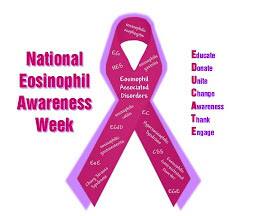
This week, May 19th-25th, 2013 is National Eosinophil Awareness Week!  If you have followed my blog for a while, then you already know something about eosinophils.  If you are a new reader, you can learn a little about Eosinophilic Gastrointestinal Disorders (or EGID), specifically Eosinophilic Esophagitis (or EoE), by reading through some of my earlier posts about our journey with 2 of our daughters and their struggles with EoE, starting with this one.

Eosinophils (E-o-'si-n-o-"fils) are a specific type of white blood cell generally associated with allergies, parasites and cancer. Eosinophil Associated Disorders are a group of uncommon (rare) chronic illnesses. While they are still considered rare, these disorders are rapidly
emerging as a healthcare problem worldwide. Yet, many patients suffering from these disorders go
undiagnosed for years due to a lack of information or awareness of these diseases.

In eosinophilic disorders, a high numbers of eosinophils accumulate in body tissues causing inflammation and damage.  These disorders are classified by body tissue where eosinophils accumulate. For example, in eosinophilic esophagitis the eosinophils attack the esophagus.
The only way currently that these disorders can be diagnosed and monitored is by tissue biopsies. What this means is that in order to be diagnosed, my daughters had to go into the operating room and have upper endoscopies and colonoscopies during which multiple biopsies were taken of the tissue throughout the digestive system.  Cassidy, pictured here, has been scoped and biopsied at least 10 times (after a while you actually start to lose track) and Chloe, who was only diagnosed a little over a year ago, has been scoped 5 times and hospitalized twice already. In both cases, during the first set of scopes, large numbers of eosinophils were found in the esophagus tissue samples when the biopsies were sent to the lab.  The only way to monitor the progress of the disease or the effectiveness of treatments is to repeatedly go back into the O.R. and have more biopsies taken. This will go on to some extent probably for the rest of their lives.

 Eosinophilic Gastrointestinal Disorders render the patient unable to tolerate food proteins. Eating food causes damage to the GI tract, pain, and symptoms similar to those you would experience from a
stomach virus. Sometimes the pain is bad enough each and every time they swallow that they just stop eating all together. Yes, really. It gets that bad. Depending on the number of foods that trigger the eosinophilic reaction, some who live with EGID need to stop eating ALL foods just to control the damage and inflammation. In these cases, the patient is given a special amino acid formula through a feeding tube. Chloe was dependent on a feeding tube for 2 months last summer, and truthfully we felt lucky that she was able to stop using it after such a "short" time. Eosinophilic esophagitis can also be triggered by environmental allergens, causing flares that can only be controlled with the extended use of steroids.

All of these are chronic diseases requiring long term treatment, with no known cure.  They are also not something that people who suffer from them will "outgrow".
Sometimes the symptoms can be well controlled with dietary changes, sometimes they require steroids, but the disorders are now believed to be relapsing and remitting, which means that you can have some success with treatment but could then have flares or relapses. During relapses and flares, these are debilitating diseases leading to missed work, school, social outings, etc.

Also, delays in diagnosis are common. Symptoms vary from person to person and can mimic other, less serious diseases. Even now with prevalence of the diseases on the rise, many doctors and nurses have not even heard of these diseases.


Symptoms of EGID can vary depending on the part of the GI
tract affected, and may include:

• Reflux that does not respond to usual therapy
• Dysphasia (difficulty swallowing)
• Food impactions (food gets stuck in the esophagus)
• Nausea and Vomiting
• Diarrhea
• Failure to thrive (poor growth, malnutrition, or weight loss)
• Abdominal or chest pain
• Gastroparesis (delayed emptying of the stomach)
• Poor appetite
• Bloating
• Anemia


If you would like more information about eosinophilic disorders or would like to make a donation to help support research, please visit the American Partnership for Eosinophilic Disorders at www.apfed.org or the C.U.R.E.D. Foundation at www.curedfoundation.org

If you think that you or someone you love may have an eosinophilic disorder, see a doctor!

If you have been recently diagnosed, please find a support group or seek out the online EOS community. Knowing that you are not in it alone can really make a huge difference, especially on the roughest days. You can learn about some of our own experiences with EoE in some older posts and in other blogs around the internet. Most all of us are willing to discuss our experiences.

I welcome comments and messages from anyone with anyone from the EOS community or anyone at all with questions. 

Friday, October 26, 2012

Feeding Chloe

 School starting as well as ballet, jazz and karate have really kept us busy around here!  A few things have changed for now with Chloe, so I wanted to write a post for my followers that are family, friends or EOS/food allergy readers.  To briefly recap, Chloe was diagnosed with eosinophilic esophagitis (also called EE or EoE) in late March 2012.  She was started on medication, a proton pump inhibitor (or PPI, such as prevacid) and had repeat biopsies done 6 weeks later on June 13th 2012.  At that point she had gotten much worse, with her eosinophil cell counts doubling and her esophagus covered in abscesses. She was barely eating any solid food at that point and was in significant pain.  Between the first and second scopes, we had allergy testing done (scratch, blood and patch testing) and have a list of possible triggers that would need to be tested, but first we had to get the damage in her throat under control.

Once the second set of biopsies came back looking so bad, she was started on a regiment of swallowed steroids to help control the inflammation. About 2 weeks after she started that medication, on July 11th 2012, she vomited blood and I took her to the E.R.  She only vomited once, and her hemoglobin was normal, but she was quite fragile and was admitted for overnight IV fluids.  It was almost a week before she came home.  The steroid, which she is still on, had caused a fungal infection on top of everything else and she could not eat at all.  At the point of her hospital discharge, she needed an NG tube for nutrition and calories because she was still unable to eat enough.  Following a round of anti-fungal meds, she was only marginally better and only eating only small amounts of yogurt and watered down apple juice so she had a third endoscopy with biopsies on August 15th 2012.  That set of lab results showed that while her eosinophil counts were way down, she still had a fungal infection.  The original infection was so severe that the first round of meds did not get rid of it, so she started on a 3 week course of stronger medication.  By that point, she was taking the anti fungal, a barrier medication to protect her esophagus, the PPI and the steroid, and eating more but still not enough to remove her feeding tube.  In addition school started, so we were glad that she was eating enough to at least skip her lunch bolus so she didn't have to be hooked up to her feeding pump for an hour at school.

One of the things that had come up before and seemed to be an issue again was that when Chloe eats, or has a tube feed in recent cases, that food stays in her stomach for hours, much longer than it should.  This is called gastroparesis, or delayed gastric emptying.  We have not yet had a scan to formally diagnose this condition, but I can say for certain that she will sometimes vomit undigested food 6 to 12 hours, or more, after eating it, and even the liquid diet pumped through her feeding tube will remain in her stomach for several hours which is easy to determine when doing pH checks before starting a new feed.  Gastroparesis can cause stomach pain, vomiting and a constant feeling of fullness which decreases appetite and ability to eat.  These are all symptoms that Chloe has struggled with pretty much her entire life and are in addition to the EoE.  Because of this, she has also started taking a mini dose of erythromycin.  Erythromycin is an antibiotic, however it has the side effect in some people of increasing gastric motility.  Because of this, it is sometimes used to treat gastroparesis.  She has also started taking a prescription antihistamine, and this medication is also being used in Chloe's case for the side effect, not for the antihistamine properties, but because it sometimes acts as an appetite stimulant.

On September 14th, which happened to be our 9th wedding anniversary, we removed Chloe's feeding tube.  About a week later, we stopped the barrier medication, Carafate, since the tube is no longer in and because it can also interfere with the absorption of some other meds, including her PPI and steroid.  At this point in time, Chloe takes the PPI, the steroid, the erythromycin and the antihistamine daily.  She does seem to be eating more, and since the tube came out she has lost just under 3 pounds and is holding steady at 38.2 pounds, which we are happy with.  So the good news is that she is maintaining her weight and while she does still have stomach aches, they are no longer constant.

With her fungal infection gone and her weight at a comfortable level, we got the OK from the doctor to start trying to eliminate foods to control her EoE without the use of steroids.  She has had so many other issues that needed to be dealt with and stabilized first and now that we at least temporarily have some of those things under control, it seems like a better time to start removing foods. Over the last 3-4 weeks she has started complaining more that her throat hurts again. Irritation from the NG tube should no longer be an issue. At the time of her last scope her eosinophil counts were way down, and we have assumed this was because of the steroid.  However at the time that those bioposies were taken, she had not only been on the steroid for 6 weeks, but she also had be fed a diet consisting almost exclusively of hypoallergenic elemental formula, so it is possible that the good results that we had were the result of a combination of the steroids and the restricted diet.  If that is the case, it would explain the return of her pain once she began eating an unrestricted diet again despite still being on steroid medication.  Either way, the hope is that she will start feeling better now that we have removed some foods from her diet.  The first batch, based on the allergy testing in the spring, is all dairy, eggs, peanuts and wheat. Then hope is that if she sticks to this diet for 6-8 weeks, her symptoms will fade and the damage will heal, which will mean that we have properly identified all of the foods that trigger her eosinophilic reaction. It has been almost 2 weeks and so far she has shown no improvement, but it's still a little early to tell.  In another 10 days if she is not starting to feel better, she will have to go back into the O.R. for another scope and set of biopsies.  I'm hoping that things turn around before then, but if not this will be her 4th trip to the O.R. in 7 months. Though she is complaining that her chest and throat are feeling worse, she is still eating pretty well and as of Thursday was still 38.4 pounds, which is a relief even if she does need another procedure.

All in all, she has handled everything that she has been through in the last 6 months really well.  After all, the kid is only 5 and she has been in and out of the operating room 3 times, hospitalized for a week, feeding tube dependent for 2 months and loaded with medications.  She has now had to drastically change her diet and despite pushing through all of this with uncommon spunk, she has been in varying levels of pain the entire time, and probably for almost her entire life. 

She decided to be Wonder Woman for Halloween this year, and when I asked how she chose that, she told me that she wanted to be a super hero, but if she went as herself, it wouldn't be dressing up. Good point, little one.  She's one of my heroes, that's for sure. 

Sunday, August 12, 2012

August EOS updates

As I have mentioned in some of my past posts related to the girls' EoE, the diagnosis was life altering for Cassidy, and for all of us.  She requires daily medication and a drastically restricted diet.  She also repeatedly heads into the O.R. for endoscopies and biopsies to monitor the progress of the disease or how well we are doing as far as keeping things under control. The chances of a sibling also having an eosiniphilic GI disorder are less than 10%, some sources say as little as 3%, but in March, Chloe was also diagnosed.  So far things with Chloe have made our experience with Cassidy seem like a stroll down easy street.  But I'll get to that shortly.

I gave a detailed update on Cassidy as far as the EoE and her chronic microscopic colitis is this post, so if you follow my blog to keep up with the girls and you missed that one, it's worth reading.  As mentioned in that post, Cassidy had a CT scan and ultrasound coming up, both were normal which ruled out any structural problems or anything like gallstones as the cause of her colitis or her severe bouts of mid and upper abdominal pain, which were happening 2-4 times a week. We also strictly removed gluten from her diet which, given the other limitations in her diet, has been no small task.  That started on July 6th and don't you know, she has not had a single episode of crippling pain since that day.  She is also less achy, has more energy and just feels generally better.  No matter how hard it is to be free of gluten in addition to eggs, milk, peanuts and a variety of fruits and veggies, it is TOTALLY WORTH IT!  The last step is to try taking her off of the Asacol, which she takes for the inflammation in her colon.  I'm hoping that gluten was the culprit of everything below the esophagus all along, but I'm not completely sure at this point.  She ended up going without her Asacol for 5 days recently, and she did have some pretty severe muscle spasms and changes in her bathroom habits.  It may have been a coincidence, we will know for sure once we officially take her off of the medication for a trial run without it.  Until then, stay tuned, because as of now things are falling into place nicely for her.


Then of course we have Chloe.  Her last update was on July 8th, and she we had gotten pretty bad results from her last scope and biopsy set in mid June.  She had started on a steroid treatment in an attempt to heal the damage in her esophagus.  On July 11th, three short days after I wrote that post, Chloe woke up complaining that she wasn't feeling well, and she was quite lethargic.  She had been dragging a little the night before, but she had begrudgingly eaten dinner as best she could (she was hungry but her throat hurt) and then gone to bed fairly easily.  I knew in the morning that she really didn't feel well, because it was the week of dance camp and she was supposed to be going home from camp with her good friend Elizabeth for a play date.  But she laid on the couch when it was time to get dressed and asked me if she could do it all another day.  So I agreed, let Elizabeth's mom know, asked my mom to come over in case I needed to take Chloe to the doctor later, got Cassidy ready for camp and loaded everyone up.  Right after we dropped Cassidy off, Chloe threw up all over the car.  I pulled into a parking lot to clean her up and realized that the vomit was bloody. So I stripped her down, moved her to Cassidy's seat and headed home to drop the other 2 kids off (thank goodness I asked my mom to come over!) and took her to the E.R. at AI DuPont children's hospital.  Lab work showed that there were no signs of ongoing internal bleeding, but she needed IV fluids and her blood sugar was very low.  Strange, since she ate dinner, had juice in the morning, and vomited undigested food from lunch the day before. They decided to keep her overnight with an IV to make sure she was well hydrated.


So began our almost week in the hospital.  That's right, it wasn't until several days later that she was finally discharged.  She complained of throat pain so severe that she wouldn't eat anything some days, or a few ounces of yogurt others.  She was so depleted from not getting enough to eat for so long, and the doctors were concerned that without the IV and unwilling to eat, she would end up back in the E.R. very quickly.  They also could not tell us why she was having such severe pain.  It's likely that she had been in such pain for a while, but her survival instinct forced her to eat just enough to scrape by.  Now that had an IV to keep her hydrated and help with her blood sugar, it just wasn't worth it.  Also, maybe the steroid treatment had caused a fungal infection in her throat.  No one knew for sure, so she kept the IV and started on an anti fungal medication in addition to the steroid, PPI and a type of coating or barrier medication called Carafate.  The purpose of that last one is to protect the tissue while the other meds have a chance to work.  A few days into the anti fungal and she still refused to swallow.  So we began to discuss placing a feeding tube.  It basically came down to this.  She won't eat or drink, so she either has to stay in the hospital with IV support or go home with another form of hydration and nutrition, which would be the NG tube.  By now the tube seemed more appealing.  In addition, there was also a sense that she needed the nutritional help anyway.  The poor kid had barely gained weight, if any at all, for over a year and a half if I'm not mistaken.  That was part of what landed us in the O.R. looking for a diagnosis in March.  So the tube was placed, I was trained on how to remove it and put it in as well as how to use her feeding pump and how to break down her feeding into calories and how much to give and when.  The next day, she got to come home.  At the time, the thought was that it would help her maintain her current weight and give her a couple of weeks of resting her throat while her meds worked.  It would hopefully act as a bridge to get us across the difficult spot we were in. That was almost 4 weeks ago, and Chloe is still taking very little by mouth.


Next week she will head back into the O.R. for yet another endoscopy with biopsies.  This time none of us know what we are hoping for or what to expect.  Something is making Chloe not want to eat, and none of us, including her doctors at this point, know what it is.  My biggest concern today is that the scope will not show much, and that we will have no answers which also means nothing to treat.  Regardless, the bottom line is that no matter what we do or do not find, until Chloe will eat enough to sustain herself in terms of both calories and nutrition, she will need the support of the feeding tube.  She does seem to have a problem with her stomach emptying very slowly, so I'm sure some additional testing will be scheduled to look into that.  As with Cassidy, anything like that which is diagnosed will be in addition to her EoE.  So at some point, which will be dependent on the condition of her esophagus, we will have to determine for sure which foods trigger the eosinophilic response.  At times it can be difficult to decide which medical condition to tackle first, so we will check
with  her doctor as far as that goes.


It has also become clear over the last month just how much she needs what she is getting through her NG tube.  In the 3 and a half weeks that she has had it, she has gained a full 5 pounds.  That's about a pound and a half a week! And she actually is visibly relieved to have the tube most days.  If she tries to eat and finds it too painful, she doesn't have to choose between feeling weak and hungry (what Chloe calls "that wobbly feeling") or forcing herself so suffer through the pain.  She does her best, then just asks for her feeding pump.  She is also needing less sleep, having fewer headaches and has plenty of energy to run, laugh and play, which is exactly what a 5 year old should be doing during summer vacation.
She will be starting kindergarten with her feeding tube, although that is just fine with her.  Rather than slowing her down, it has made her feel so much better, possibly than she has ever felt. It is very difficult to see your child with tubes coming out of them all day, and sleeping at night while connected to the feeding pump on an IV pole. It's hard to interrupt her playground games to give her medication or connect her for a feed or flush her NG tube.  Keeping a change of clothes and a bucket in the car in case she vomits her formula up while we are out running errands.  Having to double check that we have the formula, pump, backpack, Ph strips, syringe, bottled water and medications also in the car
 before we leave the house. It is heartbreaking when the tube needs to be changed; pulling it out burns and pulling the medical tape off of her delicate skin hurts.  And having her Daddy or Grammie hold her still while I feed tubing up her nose, down her throat and into her stomach while she gags and cries, then taping it to her face and pulling out the guide wire, withdrawing gastric fluid from the end to check placement of the tube, which makes an already crying child visibly more anxious because she is afraid that if it is not quite right she will have to go through the whole thing again.  It's really hard.  But she is also looking less painfully thin.  Her cheeks are pink, she has the energy to play, and maybe best of all, she is smiling a lot more.


This is the short version of Chloe's situation, and so many details have been omitted.  If you have any questions, I welcome them, even if they seem rather personal.  Please feel free to leave them in the comments!

Once school starts and we are settled into a routine, and once things slow down a bit for Chloe, I hope to get back to blogging, probably weekly, and back to recipes and tutorials as well as continuing updates on our life with 2 children with EOS.  In the mean time, thanks to everyone for your support!


Thursday, August 2, 2012

Best Part of Summer...Jam!

I thought this blog needed a sunnier, brighter, yummier post after the last couple.  Now I know that those of you following me to keep up with the girls (or eosinophilic disease in general) are probably waiting for an update on Chloe's recent hospitalization, but it's time to throw my recipe followers a bone!  It all ties in anyway.  On days when everyone was feeling well several weeks back, we went cherry picking at local orchards, which I mentioned at the end of this post.  We picked buckets full of red and yellow sweet cherries.  Some we ate fresh, some became beautiful sweet cherry pies, some were transformed into bubbly warm cherry crisp.  And some, perhaps my favorites, were put up as jar after jar of cherry jam.  We made small 4 ounce jars as thank you gifts for Cassidy's teachers and other special school staff.  We made basic cherry jam, some of which we shared with friends.  Then, in an effort to use up some other fruit before it was past it's prime, I whipped up a batch of spiced cherry grapefruit jam.  And it is nothing short of amazing.


I thought it would be nice to share my cherry jam recipes with you today.  For those of you new to canning, I'll go through the process that I use step by step.  The purpose of processing jam in a boiling water bath canner is to make it shelf stable, meaning that you can store it safely in the pantry rather than the refrigerator for at least a year.  If you would rather just keep your jam in the fridge, skip the processing step, and once the jam is ready, just fill the jars with it and pop them in the refrigerator where they will keep for at least 3 months (if it lasts that long!)

If you do decide to process the jam and the whole thing is brand new to you, you do not need to invest in tons of fancy equipment.  You can process the jars in any stock pot (with a lid) large enough to cover the jars with at least one inch of boiling water.  A large stock pot is generally large enough to accommodate standard jelly jars.  You will need something to keep the jars from resting directly on the bottom of the pot.  You can simply fold up a dishtowel and place it in the bottom.  Finally, you will need a way to get the hot jars out when they are finished processing.  So to recap, stock pot, dishtowel, tongs, canning jars.  You probably have everything except the jars, which you can buy in cases of 12 for around $12 at big box stores, kitchen supply stores and many grocery store, especially during the spring and summer.


Accessory Set
Canner with jar rack
If you decide you want to go ahead and jump in to canning, spend a little cash and just buy a canning starter kit.  You can buy the canner with jar rack and accessory set (everything you need except the jars) for about $40.  There are also a variety of options out there in a variety of price ranges, such as the accessory set only (this includes a jar lifter, a lid lifter, wide mouth funnel and a few other things, and is very helpful) for around $10-$15, and I believe the Ball company makes a home canning "Discovery Kit" made to use with a stock pot, which includes a silicone lift out jar rack.  So there are a variety of options in a variety of price ranges depending on your comfort level and what you are willing to spend.  I can a great deal, so I have a big canner and an accessory set.  But the equipment that I have, while good quality, is basic and without bells and whistles so to speak.  I prefer it that way, and it works just fine.


 First, my disclaimer: I have attempted to share safe preserving methods. However, I make no promises. You alone are responsible for your health. Be aware of current safety recommendations. There is a wealth of information from licensed sources about current canning standards available for free on the internet. This is the way that I can for myself and my family. You alone are responsible for your health!

Let's get started!


 1. Wash the jars and lids.  I put my jars in the canner while the water is heating to boil, to make sure they are sterile.  The lids are made up of a ring and a flat lid piece.  Set the rings aside and put the flat lids in a small sauce pan with water.  These you need to warm to just below a simmer, over really low heat.  Do not boil them!  This primes the sealing compound around the edges.


2. Fill the canner or stock pot with enough water to cover the tops of the jars by 1 inch once they are full, and put it on the stove to boil.  This is when I stick my clean, empty jars in, but if you have washed the jars, I feel that this step is probably optional for jam.


 Now for the jam! Because Cassidy is allergic to apples and most commercial pectin is from apple peels, this is a pectin free jam recipe.

You will need:

Sweet Cherry Jam

5 cups of washed, pitted sweet cherries
3 cups of sugar
2 lemons


1. Cut the cherries in half or quarters or both, whatever you prefer.  Toss them into a non-aluminum pot with the juice and zest of the lemons.

2. Cook over medium low heat stirring frequently until they simmer and soften. Put a small plate in the freezer, you will use this to test for jelling shortly.

3. Turn up the heat to medium high and add 3 cups of sugar; stir until evenly mixed.  Keep stirring frequently so that it doesn't burn on the bottom.  Keep this up until the jam starts to thicken.


4. Once it looks like the jam is thickening up and starting to gel, you can do a plate test.  Grab that frozen plate from the freezer and spoon a little jam onto it.  Stick it back in the freezer for a few minutes.  Make sure you keep stirring the jam while you wait, since it is cooking quickly and at a higher temperature at this point.  You don't want to burn it!

5. When you take the plate out again, push your finger slowly through the cooling puddle of jam.  If it wrinkles up across the surface when your finger pushes into it, turn off the burner!  It's ready to go into the jars.  If not, continue to cook and stir for a little longer, then test again.  Be careful not to leave it unattended, or it can overcook quickly.  If that happens it won't taste as good.

 ***If you are making refrigerator jam, you can just fill jars with the hot jam, put lids on them and pop them in the fridge, where they will stay good for 3 months, probably even longer if they last that long!  If you want the jam to be shelf stable, go on to the next step.***


6. When the jam is ready, ladle it into the hot, empty jars (remove them from the boiling water and empty the jars, but leave the water in the pot, on the stove and boiling for processing!).  Fill them to 1/4 inch from the top. The wide mouth funnel comes in handy here if you have it!

7. With a clean, damp cloth, carefully wipe the rim of the filled jars so there is no jam or residue on them. 

8. Adjust the 2 piece canning lids, which have been prepping in hot water.


9. Put the jars on the canning rack and slowly lower them into the water. The water should cover the lids by an inch or two. Put the lid on the pot.

10.Once the water has come to a full boil again, set a timer and process the jars for 10 minutes.

11. After 10 minutes, turn off the burner and carefully lift the jar rack up.  Transfer the jars to a spot where they won't be disturbed, I put them on a towel along the back of the kitchen counter.  Let them cool completely, which may take overnight.

It's a good idea to label the jars with the date and contents.  You can use cute labels, or just write on the top of the lid with sharpie.  The lids are not reusable for canning anyway.

For more information on safety in food preservation, please go to The National Center for Home Food Preservation.


For Spiced Cherry Grapefruit jam, omit the lemon, but add the juice and pulp of 2 grapefruit, and the zest from just one of the grapefruit.  Also stir in 2 teaspoons of cinnamon while the jam is simmering.  The rest of the process is the same.

You could probably substitute most fruits for the cherries in this recipe.  Higher pectin fruits, like blueberries, will result in a thicker jam than low pectin fruits like strawberries.


Sunday, July 8, 2012

Chloe's Next Step

I realize that this post is long overdue, and that many of my readers have been waiting for an update on Cassidy and Chloe.  We have been busy with doctor's appointments, tests and procedures, new treatment attempts, and, just as important, trying to maintain some sense of just being a family and "regular" kids.  I believe my last post that included a significant update was this one, when Chloe went in for her first set of scopes and biopsies. I mentioned shortly after that post that Chloe was, in fact, diagnosed with eosinophilic esophagitis.  So here are the details on Chloe since then...

Chloe's first set of biopsies came back showing eosinophils totaling about 30 per high powered field, which exceeds the diagnostic criteria for eosinophilic esophagitis (greater that 15 eosinophils per field).  Given the fact that she was also having episodes of difficulty swallowing and food getting stuck (dysphagia) and not gaining weight well, and the fact that she has a sibling with the same disease, the gastroenterologist, Dr. A, felt confident in this diagnosis.  So he referred us back over to the allergy and immunology department to complete the 3 types of allergy testing that we went through with Cassidy, which you can read about here.  So we went ahead with the testing, and found that between the scratch testing and blood testing she showed a likely sensitivity or allergy to milk and eggs.  The patch testing was a little trickier, in my opinion.  As I have explained before, patch testing involves placing pure food samples against the skin for 2 days, them removing them.  Results are read 24 hours later.  Having gone through this with Cassidy, I remembered a few of her reactions being quite pronounced the night before the reading, but more mild by the time the doctor saw them.  In Cassidy's case, the mild reactions were still noted in her chart, and it turned out that there were 2 that she could tolerate (corn and bananas) but others that she reacted severely to when we tried to reintroduce them.  With this in mind, I wrote down the numbers of the test areas which had clearly visible reactions at bedtime the day we removed the test strips.  The next day, 5 of the 6 looked much better, showing only mild irritation, so I'm glad that I made note of them.  Hopefully they will not actually be relevant triggers for Chloe, but if removing the 2 foods with clear positive reactions isn't enough, I'll be glad that I have these additional foods to try.


The bottom line for the testing on Chloe is that eggs and milk were positive, and the additional foods that I noted were soy, wheat, celery, beef and sesame.  I learned later that during the test reading, while I thought that none of the mild irritants were noted, her chart does actually list wheat and soy as possibilities, in addition to the eggs and milk.  For now, none of that is immediatly relevant, so bear with me while I explain.

Because Chloe's cell counts were around 30, which is twice the number required for diagnosis but still on the lower end for this disease (to compare, Cassidy's counts were around 50-60 the first time), there are 2 possible treatment options to start with.  One is the method we used with Cassidy, allergy testing followed by removing all possible allergens turned up during that process for 6-8 weeks followed by repeat biopsies to monitor progress. The other option is not removing anything from the diet and just treating Chloe with PPIs (commonly a reflux medication, including brand names Prevacid and Prilosec).  Apparently, in some patients with lower counts this alone is effective.  We ended up trying the medication alone for 6 weeks, although I have to admit that shortly after this decision I just didn't have a good feeling about it.  But we crossed our fingers and hung in there.  2 weeks before the repeat biopsies (which was about 4 weeks on the medication), Chloe started eating less again, waking up in the night and eventually refusing solid food shortly before the procedure.  Mark and I went in the day of the biopsies and scopes, June 13th, with a bad feeling that things would not be much better in there.


We should have been wishing for things to be the same.  After 6 weeks on medication, Chloe's entire esophagus is inflamed to the point that the tissue looks grainy and is friable (bleeds easily),  the furrowing from the lower third of the esophagus is now extending up to include the middle third as well, and her entire esophagus is covered in little white patches, which lab reports confirm are eosinophilic abscesses. The lab listed the cell counts as high as 70, which is more than twice the number that was observed less that 2 months earlier.  No wonder she can't swallow!  Mark and I were horrified.  The gastroenterologist explained his plan of attack to us. Chloe is now on a steroid treatment for a minimum of 3 months.  After 4 weeks we will let the doctor know how she is feeling, and 4 weeks after that, she will have another scope with biopsies to confirm the effectiveness of the meds.  The point here is to help heal the damage enough that she has some respite for what she has been going through, and also to confirm that the medication is effective for her.  Once she is doing much better and has healed, we will address the issue of changing her diet, and hope that making such changes works well enough for her that she will not need to remain on steroid based medication.
Removing the food immediately may seem like a better idea, but the problem with that is that we would not know, once she gets better, which treatment is the one working for her.

So far she has been on the new meds for about a week and a half, and while she does not report any improvement in symptoms, it can take longer than this for enough healing to take place that she will feel noticeably better. She is eating a little better most days, thank goodness.  I should mention that once the allergy testing was completed, I realized that Chloe had been pretty much already on an egg and dairy free diet, mainly because of Cassidy's restrictions and also in case dairy was triggering Chloe's migraines, for nearly 6 months leading up to her first scope (when the cell counts were around 30).  We did reintroduce both in the couple of weeks before her scope, but she was no longer interested in consuming much of either.  Since she is still eating both now, it is possible that this could explain the worsening of her condition.  However, it should also be noted that while this may explain the increase in cell counts from 30 to 70, it also means that something else was causing a reaction that resulted in the initial 30 cell count biopsies.  Maybe milk and eggs will be enough, but I'm not holding my breath just yet.  I'm increasingly glad that I noted the other 5 possible allergens during her testing.


While we do our best to sort all of this out, we are also trying to make sure that Chloe and Cassidy (I'll get to Cass in my next post) are able to just be kids.  True, they don't feel great much of the time, but they still have to be encouraged to enjoy their lives.  Otherwise, it is easy to slip into a rut of feeling sorry for yourself.  Once that happens, you tend to let the disease define you rather that just be an aspect of your life.  So when they are feeling up to it, we encourage them to play, dance, create and goof off.  While they have always been close, we have noticed them growing even closer as they bond over their shared physical discomfort and and the way the disease effects each of them.  What makes them different from other kids is many ways is the same thing that makes them even more like each other, and that bond is proving to be as priceless as the sisterly bond that they have always had.

Monday, May 21, 2012

Enchiladas and Margaritas, please!

Spring is in full swing in this unusually warm year, and we have had plenty of days of what we refer to as great deck weather.  Afternoons and evenings when you just want to hang out on the deck and relax!  The kids and the dog wear themselves out playing in the yard, and we like to keep an eye on them while we work in the garden. After we bring them in and stick them in the tub to clean off after all of the good old fashioned fun, we are all ready for a relaxing dinner, after which the hubby and I like to get them all tucked into bed and then go enjoy a cocktail on...you guessed it...the deck.

Days like this, a simple and delicious dinner really hits the spot, and since it is beautiful outside but not yet super hot, we don't have to worry making the whole house sweat by turning on the oven.  Once the days and evenings really heat up, it's grill season, but in the spring (or really any time, to be honest), my favorite dinner is enchiladas.  They have to be made from scratch, I'm not really a fan of canned enchilada sauce.  Also, they have to be paired with one of 2 perfect drinks.  Mexican beer or margaritas.

I've been promising my enchilada recipe to my friend Tricia, or more specifically to her husband Amos, and (as usual) they have been very patient as life with 4 active small children and the unknown perils of gardening with the kids (yes, I said perils of gardening, but I'll save THAT set of stories for my next post, which will definitely contain another strong drink recipe) have delayed things time and again.  I hope that now that I have found the time to sit down and finish this post, which I started almost 2 weeks ago, they will find the time to enjoy it soon!

Enchilada sauce is easy to make, and while there are lengthy, multi-step recipes, mine is pretty fast and easy and I love it.  If I didn't, I wouldn't be sharing it here!  Once you get the sauce made (it's only a 10 minute recipe), throwing together the rest of the enchiladas is a snap as well.  I do add cheese to mine, but when I assemble Cassidy's I just leave the cheese out, which makes it a filling and satisfying allergy friendly recipe.  Here's what you need:


Enchilada Sauce

1/4 cup vegetable oil
2 Tbsp. flour
1/4 cup chili powder
8 oz tomato sauce
1 1/2 cups water
1 Tbsp ground cumin
1 Tbsp minced garlic
2 tsp onion powder
1-2 tsp salt, or to taste

Heat the oil in a skillet over medium heat, then stir in the flour and chili powder. Stirring constantly, cook until lightly brown.
Stir in tomato sauce.
Gradually stir in water, cumin, garlic, onion powder and salt into the flour and chili powder until smooth, and continue cooking over medium heat approximately 10 minutes, or until thickened slightly.

I usually pour this into a glass measuring cup and set it aside so that I can use the skillet for the next step, no need to wash it first!  Of course, you could always just use a second skillet.

Enchilada Filling

1 pound of ground beef
1 small onion, chopped
1 small green pepper, chopped
about 1/4 cup of the enchilada sauce that you just made
black pepper to taste

You will also need enchilada shells (Traditionally enchiladas are made using soft corn tortillas for the shells, but you could also use taco size soft flour tortillas) and green onions.


 Preheat the oven to 350 degrees. Brown the ground beef in a skillet, along with the onion and pepper.  Stir in the enchilada sauce and black pepper. Turn off the heat.


In a 9 x 13 glass pan, spread about 1/4 to 1/3 cup of enchilada sauce in the bottom of the pan. If you are using cheese (shredded sharp cheddar is best!) add some to an enchilada shell. If dairy is a concern for you, rest assured that these are very satisfying and filling with or without cheese. Scoop some filling into the shell.  Wrap closed and place seam side down in the pan. Repeat until you have run out of shells or space in the pan. If you are lucky, you run out of both at the same time!  
Pour the remaining enchilada sauce evenly over the top and top with more cheese (if you are using cheese, of course!) 
Finally, top with sliced green onions.
Pop into the preheated oven for about 20 minutes, and you are all set!

 Something to drink with that?

Strawberry Margaritas (or slushies, for kids and non-drinkers!)


3 cups of strawberries, washed and stems removed
2 cups of ice
1/2 cup tequila
1/2 cup fresh lime juice
1/4 cup triple sec
lime wedges and/or strawberries for garnish


Toss it all in the blender and whirl away.  Some people prefer sugar also added to these, but that makes it too sweet for me.


If you would rather have a non-alcoholic slushy, leave out the tequila and triple sec and add 1/2  cup of orange juice.


Hope you enjoy!


Wednesday, April 25, 2012

Allergy friendly party food for kids

My regular readers know from my last post that we are very excited for Chloe and Quinn's birthday party this weekend!  My regular readers also know that we have many dietary restrictions due to Cassidy's EoE (more on that here) and will likely have even more in the future since Chloe has also been diagnosed. I don't expect the world to accommodate my children's food allergies, but this is a party for them and I feel strongly that they should safely be able to eat pretty much whatever they see under such circumstances.  As I have mentioned before, our current list of allergens for Cassidy includes dairy, eggs, cauliflower, cucumbers, cantaloupe, peanuts, apples and zucchini.  In addition, there will be several other party guests with allergies, in some cases life threatening ones, to shellfish, peanuts, eggs, milk and tree nuts.

 When we have a birthday party for the kids, either for family or for friends, we usually have basic finger foods for grazing, but we try to name the snacks things that fit in with the theme.  Makes it easy, it keeps it fun.  For this years Star Wars/Woodland Fairy party, Quinn's side of the table will have Vader Veggies, Wookie Cookies, Death Star Donuts and maybe some Jedi Juice.  Chloe's side will have Fairy Berries, sticks and branches (pretzel sticks and rods) and Pixie Heart Cookies.  Both sides of the table will have cupcakes, too.  All of the food will be allergy safe for Cassidy as well as all of the party guests. 

To start with, because allergies to peanuts, tree nuts and shellfish are often life threateningly severe, I choose to just avoid these completely when we are hosting a party for children.  I'll make the cupcakes (I have yet to find delicious cupcakes that meet our allergy needs without making them myself).  I use the chocolate cake recipe from the Food Allergy Mama blog, which you can find here.  If you are a new or seasoned food allergy baker and are not familiar with this blog, you should really check it out! Her recipes use regular ingredients that you probably already have in your kitchen or are readily available at grocery stores.  Love that!

The fruit and veggies are easy to pick up; I order the veggie tray without cauliflower since it is Cassidy's favorite and she can't have it.  She is old enough to know that she should just avoid the cucumbers, and they are always a favorite with everyone else, so we keep those on the menu.  The fruit tray we just order without cantaloupe, easy peasy. We will have juice boxes, which pretty much all contain apple juice, so I also get a couple of packs of chocolate soy milk boxes.  That way Cassidy has something to drink, and of course any other kids with (or without) milk allergies are welcome to them as well. Pretzels are safe for everyone and another option is plain potato chips.  Just make sure they aren't cooked in peanut oil!


Other than that, since I have been busy making fairy wings, light sabers and goody bags, the donuts and all of the cookies (chocolate chip, star wars and hearts) I ordered from my FAVORITE allergy friendly baker, Jenny.  She keeps a vegan kitchen (certainly no shellfish, eggs or dairy there!) and has designated bowls and utensils for baking without peanuts and tree nuts.  Her baked goods and candy are fantastic and very reasonably priced.  She also has always been able to accommodate our extensive allergy needs.  She saved the day for our Christmas celebration, and has saved me endless stress by providing the cookies, donuts and candy for Chloe and Quinn's party.  Aren't the heart cookies pretty?  Those are also her sparkle mini donuts pictured at the top of the page. To check out her other selections, place an order or contact her, you can visit her Etsy shop, HippieCakes, here.

Once we introduced food allergies into our already busy life with 4 kids, a dog and 2 self employed parents, I had to officially accept that I cannot do everything myself.  While this has always been true, (for me and for everyone else on the planet if we want to be honest) in order to give my kids the care, attention and emotional support that they need as well as still allowing them to be kids all while maintaining at least a little bit of my own sanity, I have had to formally accept that I am not superwoman. 

This week my laundry is piling up and the house is messier than usual, but it's a small price to pay for the look on my kids' faces during their birthday party.  Besides, I'd rather make fairy wings and light sabers with my kids or snuggle on the couch and read to them.  This week we have streamlined the process of creating a birthday party that is worry free for food allergy kids (kids shouldn't have to worry at birthday parties anyway!) and sure to be fun for all. That's like conquering our own little corner of the world! Everyone is safe, well fed and very well loved at the end of the day, which is certainly a priority as far as I am concerned. I guess the laundry will just have to wait until next week.

Monday, April 2, 2012

Here we go again...

I was amazed at how many people read my post on Eosinophilic Esophagitis (EoE) and our journey through the diagnosis and treatment of the disease with our oldest daughter, Cassidy.  The post, which you can read here, gave a very abbreviated version of the story, but I think the basics were covered as clearly as possible.  It was a hard road, and still is, and it certainly altered our lives.  Shortly after Cassidy was diagnosed in June 2011, we started to see some concerning signs in Cassidy's little sister, Chloe.

 I should first explain that Chloe has always had a rough time in some ways.  She is by far the most easy going of the 4 kids, and like all 4 kids, she has always met or exceeded her developmental milestones and that sort of thing.  We are thankful for that.  But Chloe has been through plenty.  She had severe newborn jaundice, and was admitted to the children's hospital when she was 5 days old for a couple of days when it reached a dangerous point, but she recovered quickly, well and fully.  By the time she was 5 months old, she had eczema so severe and spreading so quickly that the pediatrician had already sent us to a dermatologist, who had in turn already sent us to a pediatric specialist because he ran out of options that he felt comfortable with for an infant that young.  For 2 years, she saw the head of the Allergy and Immunology department at AI DuPont Children's Hospital every 2 to 3 months. For the first year of that process, it was a struggle just to keep things from getting worse.  We tried everything.  I went on a 5 food elimination diet while nursing twins (not eliminating 5 foods, I could only EAT 5 foods), we bathed her in distilled water, she had a rotation schedule for her medications for the eczema, which at times was open or scabbed skin that covered almost 2/3 of her body. That meant that she was prone to bacterial infections, which had to be treated with topical or oral antibiotics (usually topical) which then caused fungal infections.  It was no joy ride, that's for sure.  By the time she was 2 and a half, we had her skin pretty well controlled.  It was just before that when she started complaining of "owies in her head".  So, at 2 and a half, she was diagnosed with classic migraine headaches.  They run in the family, with juvenile onset even, but not at 2 and a half.  She still has migraines and eczema, and has had an increasing record of poor weight gain and low grade fevers.  She also went through an extended period of frequent vomiting. As we learned more about eosinophilic disease with Cassidy and struggled to get her health under control, we saw Chloe start to go down hill rapidly as well.

When Chloe started complaining of chest pain (Cassidy's biggest symptom), I took her to the pediatrician to get a referral to the same specialist that Cassidy sees, Dr. A. At that visit, we learned that while she has gotten taller, she has not gained any weight for a year and a half.  The regular doctor referred her over immediately, and before we even reached the first appointment with Dr. A, she started to have episodes of dysphagia, which means trouble swallowing or, in her case, food getting stuck in the esophagus.  Dr. A moved her into an urgent slot and saw her immediately.  Within a few weeks, he had her in the O.R. for scopes and biopsies.  I started this post in the surgical waiting room at AI DuPont, while Chloe was having her upper endoscopy, colonoscopy and biopsies. She did pretty well with the procedures, and now we are waiting for the lab results so we know exactly what we are dealing with.  I have seen a huge show of support from friends and family, which we all deeply appreciate.

Assuming that Chloe's diagnosis of an eosinophilic disease is confirmed with the biopsies, which is highly likely, we can only hope that it is no more severe than Cassidy's, that it is confined to the esophagus which is much easier and safer to treat, and that her list of forbidden foods is at least partially the same as Cassidy's. In order to have a diagnosis of EoE, biopsy results must show at least 15 eosinophils in at least 2 high power fields in biopsies of the esophagus.  Cassidy's biopsies showed 50-60 eosinophils per high power field in each of 11 different biopsies taken of her esophagus. How Chloe's numbers compare to those remains to be seen, but we should have at least some answers from the lab by the end of this week.

I will be sure to post updates here on the blog for friends and family members, or concerned readers.  Please leave me a comment or send me a message if you have any thoughts, questions, or words of support.

For more information about eosinophilic diseases, please visit www.apfed.org.

Saturday, March 17, 2012

What the heck is EoE?

I have mentioned before that I realize that we have not had much of a winter this year.  The weather was unbelievably mild.  That doesn't mean I am any less appreciative of the spring!  Spring and summer are by far my favorite times of the year.  i don't even mind the extra rainy days during the early spring.  During the worst part of the winter, we (and by "we" I mean my awesome husband) are busy planning our gardens for the year.  We double check our supply of canning jars and organize our planting charts for the season.  By late February,  we have seedlings started inside and are counting the days until we can start hardening them off.  Once St. Patrick's day rolls around, the cool weather veggies, like the peas, are in the ground and already sprouting and the apple tree is pruned.  The blueberry hedges, plum tree and fig tree have new buds growing and the forsythia is starting to bloom.  As much as it sounds like a cliche, it is a time for new growth and possibilities.

This time last year, Cassidy, at the age of 6, had just been referred to a specialist at AI DuPont Children's Hospital.  Friends and family would ask how Cassidy was doing, and we would say "Well, honestly, Cassidy isn't doing too well..." but we had no concrete answer as to why.  She had been complaining of chest pain as well as a bad sore throat for almost 3 years without anyone being able to determine the reason.  She always had circles under her eyes and she grew overly tired easily.  She had a persistent dry cough, and frequently ran low grade fevers.  By low grade, I mean right around 100 degrees, and by often I mean 3-5 times a week.  Almost every week. She had already had her huge adenoids and enormous tonsils removed.  It was a group of nondescript and fairly minor symptoms, but they never went away.  She had never been a picky eater, but we noticed her eating less.  While she has always been tall and thin (so are Mark and I), we noticed that she seemed even thinner than usual, so we took her back to the doctor, yet again.  We discovered that she had been losing weight.  Around the same time, she started having severe lower abdominal pain several times a week.  Our regular pediatrician, despite the fact that all of the tests he had run for her came back normal, agreed that something must be wrong.  He told me bluntly that no matter how long the list of normal test results was and no matter how minor and nondescript the symptoms were, that Cassidy was MY child, and if my gut instinct said that this was something bigger, then that was more than enough for him.  All pediatric physicians should be as AWESOME as our guy.

And so, because the pain was in the chest (along with fatigue, coughing and weight loss) and in the tummy (along with sore throat, fevers and again, weight loss) he referred us on to the cardiology team and the gastroenterology team at the children's hospital.  We saw cardiology first, and they quickly cleared Cassidy, which was a relief. Then we saw the gastroenterologist.  At first, he was also stumped.  He tried a few things, but nothing offered relief.  Eventually, as symptoms escalated and we had no answers, he felt that he had no choice but to look inside.  Cassidy was scheduled for an upper endoscopy and colonoscopy with tissue biopsies in June 2011.  Even the doctor was not sure what he was looking for, but in his own words, a child living with daily pain and no known cause and therefore relief was, in his practice, unacceptable.  Things looked fairly normal during the scope, so we initially felt relieved but also frustrated.  If everything looked normal, what was the problem?  Still, loved ones were asking, and we still answered "Well, honestly, Cassidy isn't doing too well..."

Then the labs came back.

That phone call, with the lab results, was the first time I had ever heard the term Eosinophilic Esophagitis.  Quite a mouthful, although at this point even my 3 year old can pronounce it. While still considered a rare disease, as are all eosinophilic diseases, it is being diagnosed more often.  This is what it means, in a nutshell.  Eosionophilic Esophagitis, or EoE for short, is one of a group of diseases called Eosinophilic Gastro Intestinal Diseases (EGIDs), and is, in some ways, an auto-immune disease because it causes the body to attack itself.  One distinct characteristic is that is triggered, usually, by food allergies, so in that sense it is an allergic disease.  It is not characterized by traditional food allergies or allergic responses.  When my daughter eats foods that she is allergic to, rather that a rash or wheezing, her digestive system, specifically her esophagus, attacks itself.  The reaction can develop and intensify over weeks after a single or several days worth of exposure to a food.  Her body releases a specific type of white blood cell (eosinophils) which then build up and infiltrate the tissues of her esophagus, causing damage.  This causes inflammation, pain, scarring and in some people difficulty swallowing or episodes of dysphagia and impaction, or food getting stuck in the esophagus.  It causes chest, throat and abdominal pain and can make food taste different and make swallowing very painful.  In addition, sometimes the child feels full too early which, along the pain of swallowing, causes them to not eat enough.  This can lead to weight loss, malnutrition, fatigue and stunted growth.  Some children vomit frequently.  These problems then lead to classic symptoms of lack of nourishment, including joint pain, headaches and bloating.  All of this combined usually means trouble sleeping and mood changes (you'd be pissed all the time too, if you were exhausted, hungry and in pain).

To quote, APFED, a patient advocacy and awareness group for eosinophilic diseases,

"Since none of these symptoms are specific for EGID, and many occur at times in healthy children or adults, the diagnosis is generally sought only after the symptoms have failed to resolve. Eosinophilic disorders can mimic the symptoms of other diseases like inflammatory bowel disease, food allergies, irritable bowel syndrome and reflux, among others."

While not generally a life threatening disease on it's own, it is certainly life altering.  Once we had a diagnosis, we had to determine the allergens.  We kept a food diary for 2 weeks to help determine which foods we should test for, then we went though 3 different kinds of allergy testing.  Scratch testing, which is histamine based, turned up peanuts and cauliflower.  Blood testing, which looks for antibodies in the blood, also showed peanuts and added dairy and eggs.  then we went for patch testing.  This looks for a  different type of reaction, one that is delayed and happens on a cellular level.  Samples of actual foods are placed in small cups and taped to the child's back for 2 full days. Then they are removed and rinsed off.  24 hours later, the results are read.  Sounds like nothing much would turn up with that type of waiting, but we were stunned.  When we removed the samples, her back looked like this:


The next afternoon, when we went to see the allergist, one small area looked like the picture to the left.  That big angry blister that would break open later and leave a scar for months?  That was zucchini.  To the left of it, with smaller but still distinct and painful reactions, were apples and bananas.  The full list from the patch testing?  Apples, bananas, cucumbers, cantaloupe, zucchini and corn.  This is in addition to the dairy, eggs, peanuts and cauliflower.  We have since determined that she can tolerate corn after all, but so far that is the only addition.  Some foods, like zucchini and dairy, we can't even test for tolerance. 
We had spent the summer growing our own organic vegetables, which she loves, and feeding them to Cassidy.  Cauliflower soup, zucchini bread, cucumbers, you name it. Now we know that it was making her sick.  Very sick.

By August, we had the full list of foods that she had to avoid, and we were very strict about it.  She is not a picky eater, but in addition to the difficult symptoms associated with the disease, we had to remove dairy.  Soy and rice substitutes were fine with Cassidy, but lack the fat content of dairy.  By September, the nutritionist told us that if she lost any more weight, literally one more pound, we would have to seriously discuss placing a feeding tube. We barely avoided that, but while she reported an improvement in the chest and throat pain, her bouts of lower abdominal pain were becoming more frequent and severe.  I'll cut to the chase.  Her repeat upper endoscopy in November showed normal biopsies of her esophagus.  The dietary restrictions and medications worked, and as long as she sticks to it she should be OK.  She could develop new allergies later, but that can be dealt with when the time comes. Her colonoscopy, however, showed mild to  moderate microscopic inflammation throughout her entire colon.  In the first set of scopes, there was inflammation but it was patchy.  The fact that it is now covering the entire colon means that it has gotten worse. By now she was already on anti-spasmodic medication (to control painful muscle spasms) as needed for pain, and she was needing it 3-5 days a week.  As a result of the test results, she has since been diagnosed with microscopic colitis, and is now on additional medication, commonly used to treat more pronounced Inflamatory Bowel Diseaeses like Crohn's Disease, for that.  It seems to be working, and she is needing the anti-spasmodic meds less often.  She also reports to us that while she still always has lower abdominal pain, it is less severe than it was.  She has gained 7 lbs since September and is feeling better in general.

Compared to many children with EoE, Cassidy's presentation was not terrible.  Some children are allergic to almost all foods, and get all of their nutrition through feeding tubes. Some get sick at a much younger age and some do not respond as well to the treatments.  As far as the colitis, it is also considered by some doctors to be an auto-immune disease, meaning that the body's own immune system attacks itself. Earlier in this post, I quoted APFED as saying that eosinophilic disorders can mimic the symptoms of other diseases like inflammatory bowel disease, food allergies, irritable bowel syndrome and reflux, among others.  They can also happen IN ADDITION TO these other diseases, which is important to remember since the treatments for the different diseases vary.  The dietary restrictions and medication for Cassidy's EoE carry no side effects, however her Crohn's meds do, and Cassidy does experience some of these including headaches, dizziness and mild nausea.  She says, however, that the relief that she gains from the medications is worth the side effects.  Neither disease is one that will be outgrown. Microscopic colitis, like Crohn's disease, has remissions and flares, but is commonly life long.  EoE is not typically outgrown, although allergens and triggers can change over time.

This year, we planned the garden without zucchini and cauliflower, at least for now.  We don't all avoid all of her allergens, but we do try to avoid flaunting her absolute favorites right in front of her.  She has done a great job as far as adapting to her situation, and is very responsible about following her dietary restrictions.  She reads labels herself and if she is unsure of ingredients she just eats something else.  She has told us that at one point before she was diagnosed with EoE, she felt so sick and was in enough pain that she thought that first scope would end up diagnosing her with cancer, so when she does get frustrated, she remembers that and her the current situation is actually a relief. This is her own perspective, and she is now 7 years old.  It reminds me to be to be thankful that while her diseases are life altering, they are not generally life threatening, and that as many times as we have gone to the hospital and O.R. for tests and procedures, we have all come home together.

Many times, people have asked me exactly what the situation is with Cassidy and her illness(es) and food allergies, so I thought the simplest way to explain to many would be to lay it out here.  This is definitely an abbreviated version of our story, so I absolutely welcome any questions or comments that any readers or friends may have.  In the mean time, putting all of this into writing, especially Cassidy's own perspective, reminds me of one thing that I believe strongly in, which is that gratitude makes what we have enough. Also, perhaps it will help my readers to understand why I'm only posting once every week to 10 days.  You see, In addition to Cassidy, I have 3 other children.  The twins, Quinn and Chloe, will be 5 in several weeks.  How are they, you ask?  Well, honestly, just like Cassidy at this age, now it's Chloe that isn't doing too well.